What is Holi?
Holi is a spring festival celebrated mainly in India and Nepal and by Indian communities around the world. It is best known for the day when people play with colored powder and water. It falls on the full moon day of the month of Phalguna, usually in March, and marks the end of winter and the arrival of spring.
Holi follows the lunar calendar, so its date changes every year. In 2027 the bonfire evening, Holika Dahan, is on Sunday 21 March and the day of colors is on Monday 22 March, although local calendars can differ by a day.
Holi in 10 lines
- Holi is the festival of colors.
- It is celebrated in spring, usually in March, on a full-moon day.
- Holi marks the end of winter.
- On the evening before Holi, people light a bonfire called Holika Dahan.
- The bonfire recalls the story of Prahlad, who was saved from the fire.
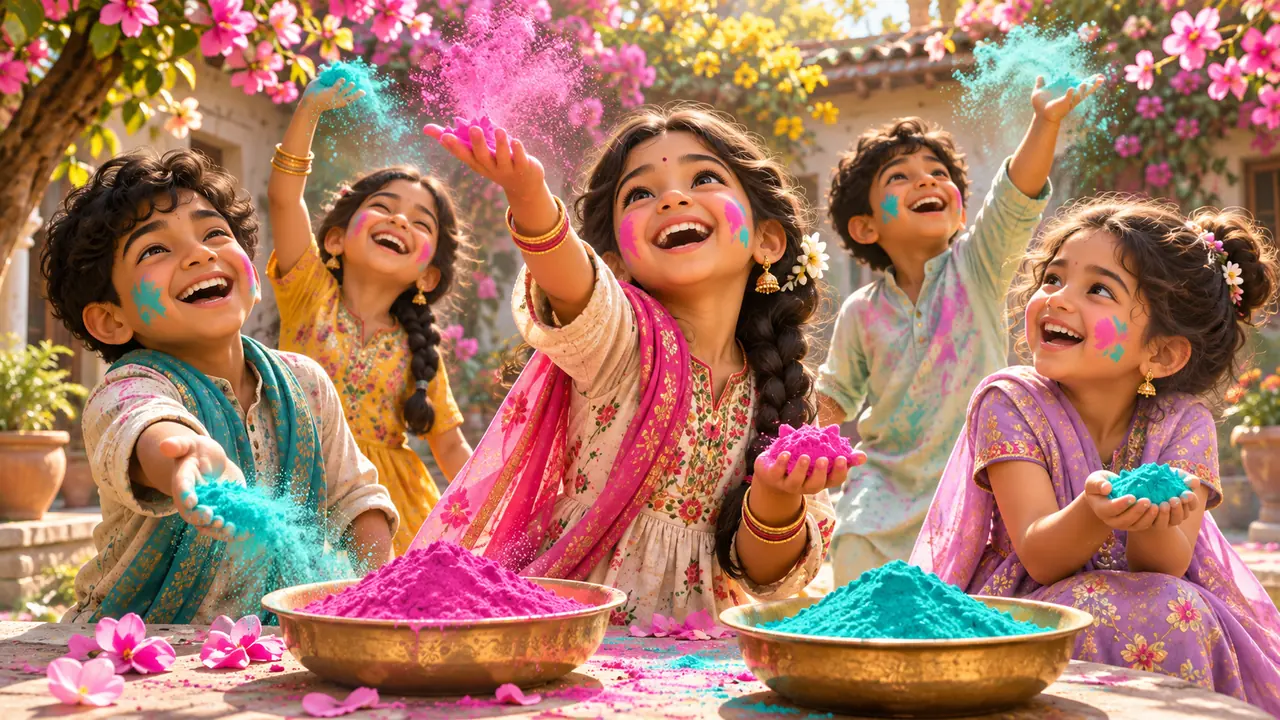
- The next morning, people play with colored powder called gulal and with water.
- Friends and neighbors greet each other with "Happy Holi".
- Families make sweets such as gujiya and a cool drink called thandai.
- It is kind to ask before putting color on someone's face.
- Holi teaches us that good wins over evil and that joy is best when shared.
Why do people celebrate Holi?
Holi has more than one story. The idea they share is that good wins over evil and that love and joy return with spring. These are traditions, and each region has its own way of telling them.
- Prahlad and Holika. The best-known story tells of Prahlad, a young boy devoted to Vishnu, and his father, the proud king Hiranyakashipu, who wanted to be worshipped himself. The king tried several times to harm Prahlad. His sister Holika, who was said to be protected from fire, sat in a blazing fire with the boy on her lap, but Prahlad was unharmed and Holika was burned. This is why many places light a bonfire the night before Holi.
- Radha and Krishna. In Mathura, Vrindavan and nearby towns, Holi remembers the playful love of Radha and Krishna. In Barsana and Nandgaon, a famous celebration called Lathmar Holi is played with colors and playful sticks.
- Spring and the harvest. Holi also welcomes the new crops and the warm season, a time when villages and families come together.
- Dol Jatra. In West Bengal and Odisha the festival is called Dol Jatra or Dol Purnima, and people celebrate with colors and processions.
The two days of Holi
In many places Holi is celebrated over two days.
- Holika Dahan. On the evening before Holi, people gather around a bonfire, sing and say prayers, remembering that good protected Prahlad.
- Rangwali Holi, or Dhulandi. The next morning is the day of colors. Children and grown-ups meet in the street or in a garden, put colored powder on each other's faces and wish each other "Happy Holi".
Colors, food and songs
The colored powders are called gulal. In the past they were often made from flowers, such as palash, and from herbs. Today many families look for natural or skin-safe colors.
Families make sweet and savory treats, such as gujiya, a sweet filled dumpling, and thandai, a cool drink made with milk, nuts and spices. Holi songs and dances fill the day, and neighbors who may not talk often stop to share sweets and a hug.
How to celebrate Holi safely and kindly
A good Holi is a happy one for everyone. A few habits help.
- Ask first. Not everyone wants color on their face. Ask before you put color on someone, and respect a no.
- Choose gentle colors. Pick natural or skin-safe colors, and keep them away from eyes and mouths. Rub oil on skin and hair beforehand so the color washes off more easily.
- Take care of water. Use water gently. Wasting water is unkind to others, especially where water is scarce.
- Look out for others. Be gentle with younger children, older people and pets, and do not throw colors at strangers or animals.