What is Lunar New Year?
Lunar New Year is the start of the new year in the traditional lunar calendars used in China and in several other countries. It is also called Chinese New Year, Spring Festival, Tết in Vietnam and Seollal in Korea. Many communities around the world celebrate it, and in several countries it is a public holiday.
The calendar follows the moon, so the date changes every year. It usually falls on the second new moon after the winter solstice, between about 21 January and 20 February. In 2027, Lunar New Year Day is on Saturday 6 February, and it begins the Year of the Goat. In some places the same animal is called the Sheep.
Lunar New Year in 10 lines
- Lunar New Year begins the year in calendars that follow the moon.
- It is also called Chinese New Year or the Spring Festival.
- It comes between late January and the middle of February.
- Every year is named after one of twelve animals.
- Families sweep and clean the whole house before the new year begins.
- Homes are decorated with red lanterns and red paper cuttings.
- On New Year's Eve, the whole family eats a big dinner together.
- Children receive red envelopes with money from their elders.
- Lion and dragon dances fill the streets with drums and music.
- The festival is about family, respect for elders and a fresh start.
The twelve zodiac animals
Each year in the lunar calendar is linked with one of twelve animals, which repeat in a cycle of twelve years: Rat, Ox, Tiger, Rabbit, Dragon, Snake, Horse, Goat, Monkey, Rooster, Dog and Pig. People often say a person has the sign of the year they were born in.
A well-known story says that the Jade Emperor invited the animals to a race across a river, and the order in which they arrived decided the order of the years. In the story the clever Rat rode on the Ox's back and jumped ahead at the end to finish first. It is a traditional tale told in many versions.
How families celebrate
Customs vary by country and family, but many people share these traditions.
- Cleaning and decorating. Before the new year, families clean their homes to sweep away the old year's bad luck and decorate with red paper cuttings, banners and lanterns.
- The reunion dinner. On New Year's Eve, family members travel home to eat together. Dishes such as fish, dumplings and sticky rice cake are popular because their names or shapes are linked with good luck and with a better year.
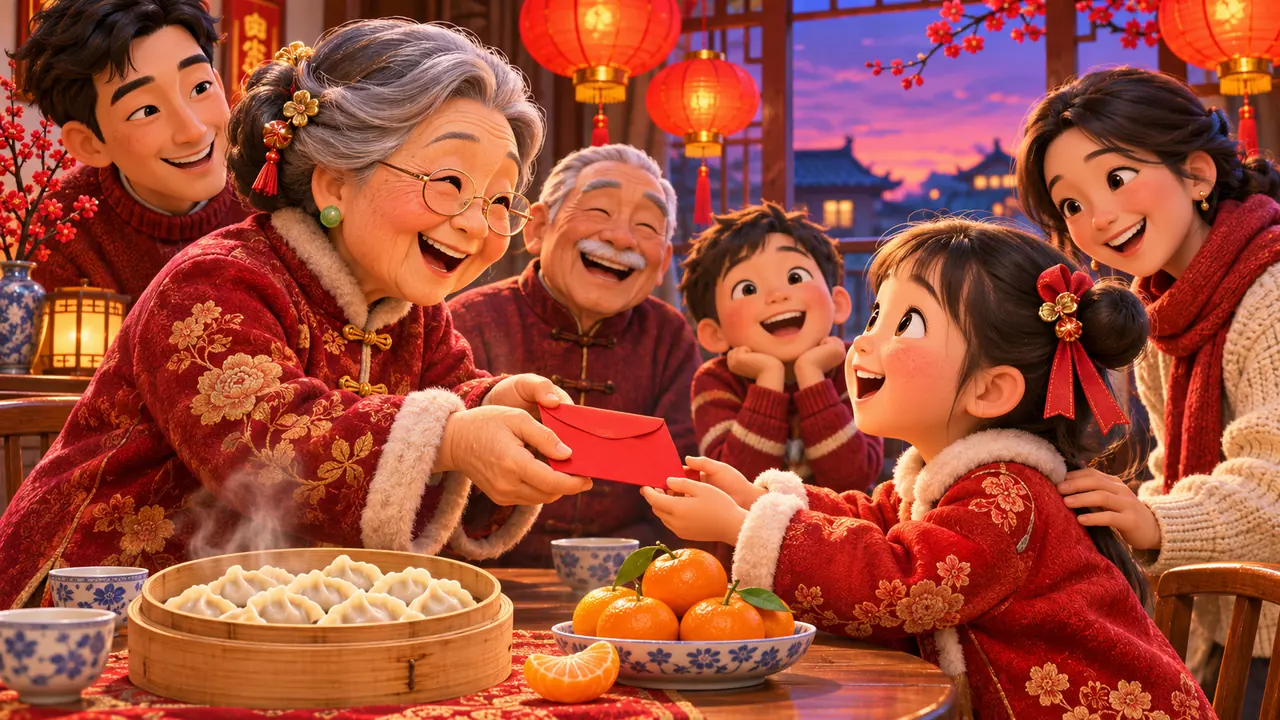
- Red envelopes. Elders give children and unmarried young people red envelopes with money inside, called hongbao in Chinese, as a wish for good luck.
- Lion and dragon dances. Teams with lion and dragon costumes dance through the streets with drums and cymbals to bring good fortune.
- The color red and noise. Red is a color of luck and joy. A traditional story tells that people used red decorations and loud sounds to drive away a monster called Nian.
- The Lantern Festival. The celebrations end on the fifteenth day with the Lantern Festival, when families hang and carry lanterns. In 2027 it falls on Saturday 20 February.
Lunar New Year around the world
In Vietnam, Tết is the most important holiday, and families make sticky rice cakes called bánh chưng. In Korea, Seollal is a day when children bow to their elders and eat a soup with rice cakes called tteokguk. Singapore, Malaysia and Indonesia, and cities such as London, San Francisco and Sydney hold parades and street markets. In India, the Chinese community in Kolkata celebrates with lion dances and food.
What Lunar New Year teaches
At the center of the festival are family, respect for elders and gratitude. It is a time to mend quarrels, to thank the people who help us, and to start the year with hope and kindness.