What is Ganesh Chaturthi?
Ganesh Chaturthi, also called Vinayaka Chaturthi, is a Hindu festival in honor of Lord Ganesha. It begins on the fourth day of the bright half of the month of Bhadrapada, usually in August or September, and in many places it lasts ten days.
The festival follows the lunar calendar, so its date changes every year. In 2027 it is expected in early September. It is celebrated all over India and is especially large in Maharashtra, and also in Goa, Karnataka, Telangana, Andhra Pradesh and Tamil Nadu, as well as by Indian communities abroad.
Ganesh Chaturthi in 10 lines
- Ganesh Chaturthi is a festival in honor of Lord Ganesha.
- Ganesha has the head of an elephant.
- People pray to him to remove obstacles and to give them wisdom.
- The festival usually comes in August or September.
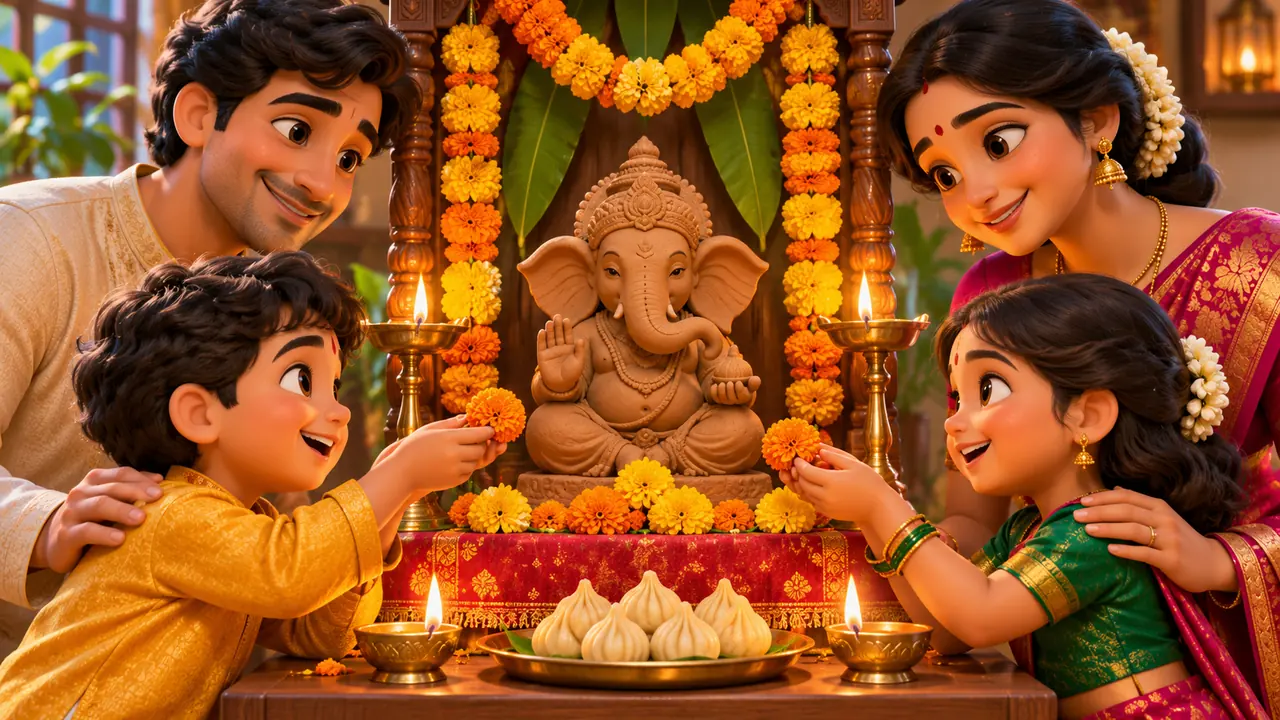
- Families bring home a clay statue of Ganesha and welcome him with prayers.
- People sing aarti and offer flowers and sweets every day.
- Modak, a sweet dumpling, is said to be Ganesha's favorite food.
- Many neighborhoods build big decorated pandals.
- In many places, the festival lasts ten days.
- Many families now choose clay statues and natural colors to keep rivers and lakes clean.
Who is Ganesha?
Ganesha is a much-loved Hindu god with the head of an elephant. He is remembered as the remover of obstacles, and as the god of wisdom and new beginnings. Many families pray to him before starting something new, such as a new school year, a new home or a journey. He is often shown with a big belly, a broken tusk, four arms and a small mouse, which is his vehicle.
People tell different stories about how Ganesha came to have an elephant's head. In one popular tradition, the goddess Parvati created a boy from clay to guard her door. When Shiva, who did not know him, returned, the guard stopped him, and the story goes on to explain how Ganesha received an elephant's head and a place of honor among the gods. Different regions and books tell the story in different ways.
How people celebrate
Ganesh Chaturthi is a festival of community, and it looks like this in many places.
- Welcoming Ganesha. Families bring home a statue, called a murti, usually made of clay, and place it on a decorated stand. The statue is welcomed with prayers, flowers and songs.
- Daily prayers. For the days that the statue stays, families offer prayers, sing aarti and offer sweets.
- Modak. Modak, a sweet dumpling filled with coconut and jaggery, is said to be Ganesha's favorite and is made in many homes.
- Pandals. Neighborhoods build decorated pavilions called pandals, where large statues are placed, and people visit to pray and to enjoy music and cultural programs.
- Visarjan. At the end, the statue is carried in a procession with music and dancing to a river, lake or the sea, where it is gently immersed. People chant "Ganpati Bappa Morya" and ask Ganesha to come again next year.
A short history of the public festival
Ganesha has been worshipped in India for many centuries, and families celebrated the festival at home. In 1893 the freedom fighter Bal Gangadhar Tilak encouraged people in Pune to celebrate the festival together in public, as a way to bring communities together. Since then, public celebrations have grown into the large festival people know today.
Celebrating kindly toward nature
Immersing statues made of plaster of Paris and painted with chemical colors can harm water and the animals that live in it. Many families now choose a statue made of natural clay, use natural colors and decorations of flowers and leaves, and immerse the statue in a bucket at home or in a tank arranged by the city. Choosing a small statue and quiet music is also kind to neighbors and pets.