What are Navratri and Dussehra?
Navratri is a Hindu festival of nine nights, and Dussehra, also called Vijayadashami, is the tenth day. The main festival falls in the autumn, in the Hindu month of Ashwin, usually in September or October. A second, smaller Navratri takes place in spring, in the month of Chaitra.
The festival follows the lunar calendar, so its dates change every year. In 2027 Navratri is expected to begin on 30 September, and Dussehra falls on 9 October, although some calendars differ by a day or two.
Navratri and Dussehra in 10 lines
- Navratri is a festival of nine nights.
- Dussehra, also called Vijayadashami, comes on the tenth day.
- The festival usually falls in September or October.
- During Navratri, many people pray to Goddess Durga.
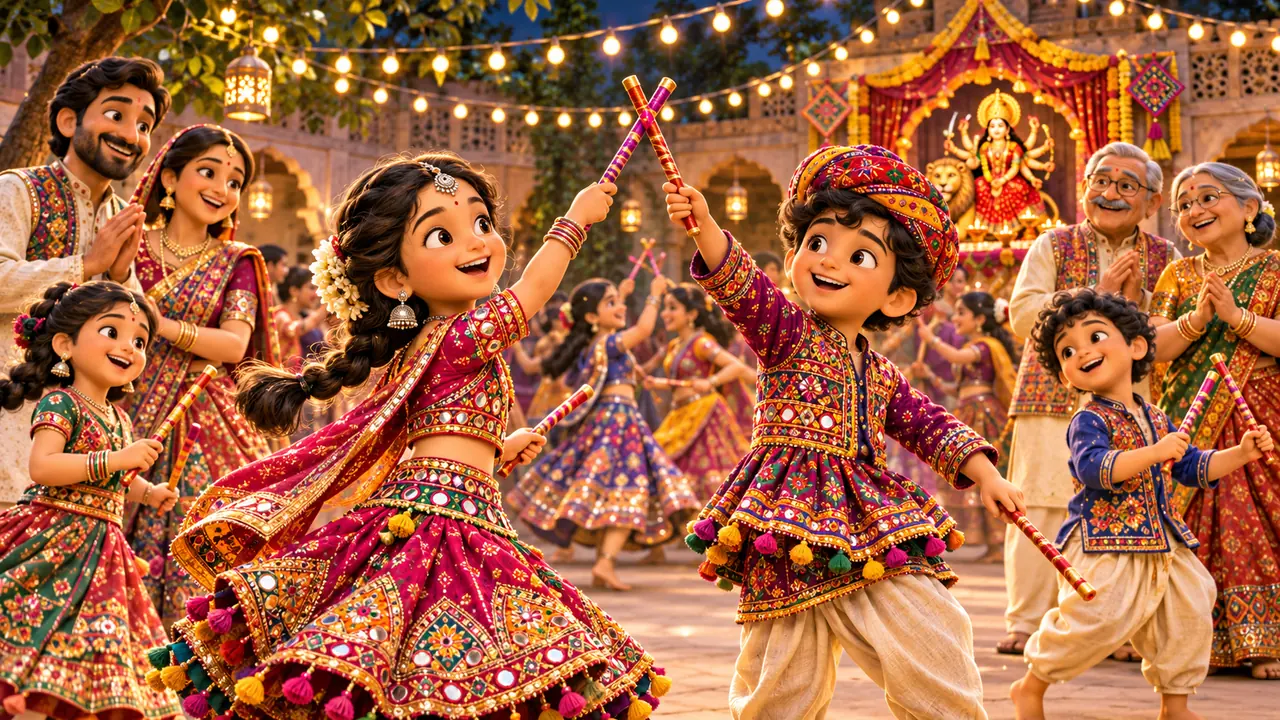
- In Gujarat, people dance Garba and Dandiya in colorful clothes.
- In West Bengal, the festival is celebrated as Durga Puja.
- Many families eat simple vegetarian food, and some fast.
- On Dussehra, people remember Lord Rama's victory over Ravana.
- In many towns, tall figures of Ravana are burned in the evening.
- The festival teaches us that good always wins over evil.
Why do people celebrate?
Different regions tell different stories, and the idea they share is that good wins over evil, and courage and truth win over pride and injustice. These are traditions, and each family may emphasize a different story.
- Durga and Mahishasura. In many places the nine nights honor the goddess Durga, who is said to have defeated the buffalo demon Mahishasura after a long battle. Each night is often linked with a different form of the goddess, and prayers on these nights ask for strength and protection.
- Rama and Ravana. In much of north India, Dussehra remembers Rama's victory over the ten-headed king Ravana in the Ramayana. It is often said to be the day Ravana was defeated, and it comes about twenty days before Diwali.
- A day for new beginnings. Many families consider Vijayadashami a good day to start something new, such as a new lesson. In Kerala, the day is often used to begin a young child's first writing lessons.
How people celebrate in different regions
Navratri and Dussehra look very different from one part of India to another.
- Gujarat: Garba and Dandiya. People dance in circles around a lamp or an image of the goddess in the evenings, in colorful clothes, and play Dandiya Raas with painted sticks.
- West Bengal: Durga Puja. Durga Puja, the biggest festival of Bengal, lasts several days. Communities build beautiful decorated pavilions called pandals, and the images of the goddess are carried to the river at the end. In 2021 UNESCO added Durga Puja in Kolkata to its list of intangible cultural heritage.
- North India: Ramlila. Communities stage plays that tell the story of Rama, called Ramlila. On Dussehra, tall figures of Ravana are burned to show that evil is defeated.
- Karnataka: Mysuru Dasara. The city of Mysuru holds a ten-day celebration with a grand procession, lights on the palace and cultural events.
- Tamil Nadu and nearby states: Golu. Families arrange dolls on steps in the home, called Golu or Bommai Kolu, and invite friends and neighbors to see them.
Food, fasting and music
During Navratri many families eat simple vegetarian meals, and some fast on certain days. The evenings are full of music, dance and sweets shared with neighbors. Many communities also hold fairs and book or craft markets in the days around Dussehra.