What is Makar Sankranti?
Makar Sankranti marks the day when the sun enters the zodiac sign of Makara, or Capricorn, and begins its journey toward the north. From then on, the days slowly get longer. This northward journey is called Uttarayana, and many people consider it an especially good time.
Unlike most Indian festivals, Makar Sankranti follows the sun and not the moon, so its date hardly changes. It usually falls on 14 or 15 January. It is also a harvest festival, a time to thank the sun, the land and the farmers for the crops.
Makar Sankranti and Pongal in 10 lines
- Makar Sankranti is a harvest festival of India.
- It comes every year on 14 or 15 January.
- On this day the sun begins its journey toward the north.
- After Makar Sankranti, the days slowly become longer.
- People fly colorful kites high in the sky.
- Families eat sweets made of sesame seeds and jaggery.
- In Tamil Nadu, the same season is celebrated as Pongal.
- At Pongal, rice is boiled with milk and jaggery until it bubbles over.
- Farmers thank the sun, the land and their cattle for the harvest.
- The festival teaches us to be thankful and to share what we have.
One season, many names
The same time of year is celebrated in many ways across India. Each region has its own name, food and customs.
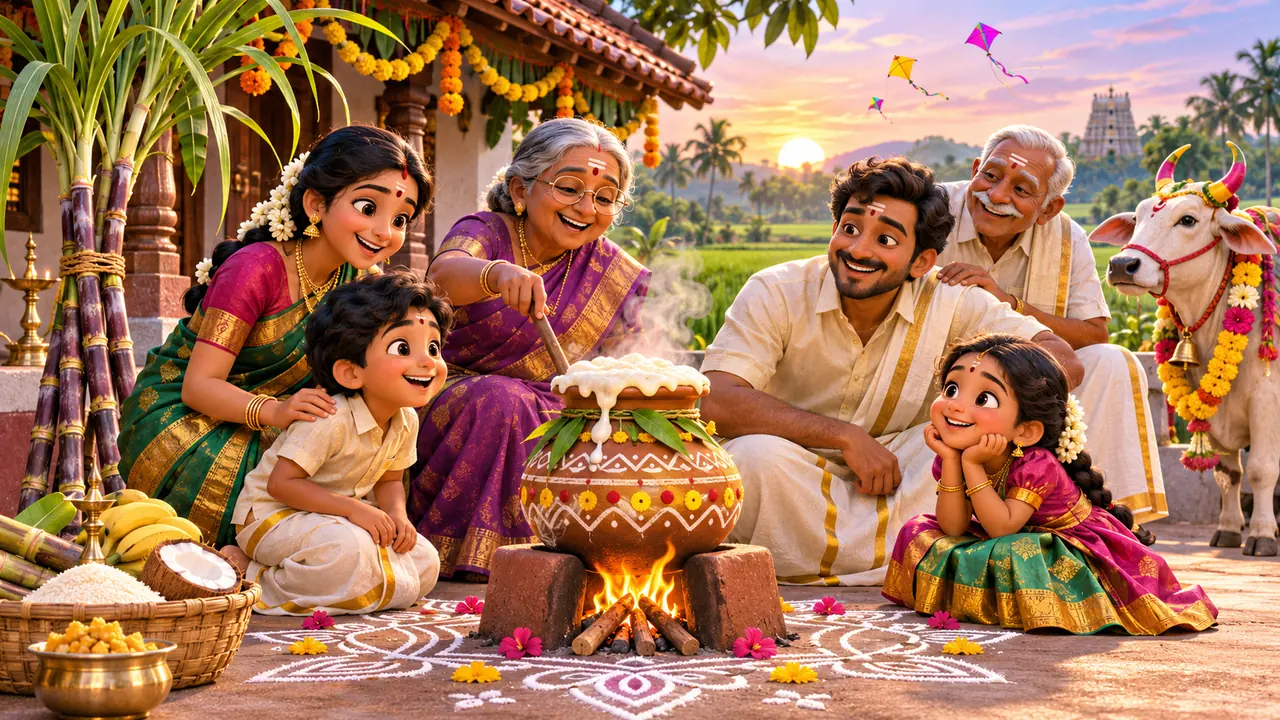
- Pongal (Tamil Nadu). Pongal is a four-day harvest festival. Families boil new rice with milk and jaggery in a fresh clay pot, and when it bubbles over, everyone shouts "Pongalo Pongal!" The four days are Bhogi, Thai Pongal, Mattu Pongal for cattle, and Kaanum Pongal for visiting family.
- Lohri (Punjab). Lohri is celebrated the evening before Makar Sankranti. People gather around a bonfire, toss in sesame, peanuts and popcorn, and sing and dance.
- Magh Bihu (Assam). Also called Bhogali Bihu, it is a festival of feasting, with bonfires and traditional rice sweets and bamboo and straw huts, built to celebrate the harvest.
- Uttarayan (Gujarat). Skies fill with kites. Families and friends meet on rooftops to fly colorful kites, and Gujarat hosts an international kite festival.
- Maharashtra, Karnataka and Andhra Pradesh. People exchange sweets made of sesame and jaggery. In Maharashtra, the greeting is "til gul ghya, god god bola", which means "take this sesame and jaggery and speak sweetly".
- Uttar Pradesh and Bihar. Families eat khichdi, a dish of rice and lentils, and take a holy dip in rivers such as the Ganga.
- West Bengal. Poush Sankranti is celebrated with rice-flour sweets called pithe, and the Gangasagar Mela takes place where the Ganga meets the sea.
Kites, sesame and sugarcane
Kites celebrate the sun and the open sky. Sesame and jaggery are warming foods for the cool January days, and sugarcane is harvested around this time. Many families also decorate the entrance of their home with a rangoli, called a kolam in Tamil Nadu, drawn with rice flour.
Pongal also thanks the cattle, who help farmers all year. Cows and bulls are washed, decorated and fed on Mattu Pongal.
What the harvest festivals teach
These festivals remind us that food comes from the soil, the sun, the rain and the hard work of many people. They teach gratitude, sharing what we have and caring for the animals and the land that feed us.
When flying kites, remember to choose a string that is safe for birds and for people. Sharp or glass-coated strings can hurt birds and passers-by, so many communities now encourage cotton string.