
A QUICK SUMMARY
The story in 5 lines
- On a hot afternoon, Finn the fox saw ripe grapes hanging from a vine on a village wall.
- He jumped again and again, and even tried jumping from a stone, but he could not reach them.
- Finn walked away saying the grapes were sour anyway.
- Tilly the bird tasted one and told him the grapes were sweet.
- Finn admitted that he had really wanted the grapes, and when the breeze shook two down, he shared them with Tilly.
Moral: It is easy to pretend we never wanted what we could not get, but it is braver and kinder to ourselves to be honest about feeling disappointed.
Source: From Aesop's Fables (Perry Index 15)
Retold by Fable Stories. How we write, illustrate and translate our stories.
Story origin: An original modern-English Fable Stories adaptation of Aesop's fable about a fox who cannot reach the grapes and decides they must be sour. The classic fable ends when the fox calls the grapes sour. This retelling adds Tilly the bulbul and lets Finn admit he was disappointed, so children can talk about honest feelings as well as excuses.
The Fox and the Grapes Story in English
It was the hottest afternoon of the summer. The hills around the village had turned brown and dry, the cows dozed under a neem tree, and even the dust seemed too tired to blow. Finn the fox trotted along the lane at the edge of the fields with his tongue hanging out. He had not eaten since morning, and he had not found a single drop of water.
Then he stopped. Along an old stone wall, a grapevine had climbed all the way to the top and spilled over the other side. Its leaves were wide and green, and right at the top hung a bunch of grapes, round and purple and shining in the sun. "Oh," said Finn, and his mouth began to water. "Those look like the juiciest grapes in the whole world."
A small bird with a dark crest and a bright red patch under her tail was sitting on the vine. Her name was Tilly, and she liked to sing, and to watch. "Good afternoon," she chirped. "Hot, isn't it?" Finn hardly heard her. He was looking at the grapes and measuring the wall with his eyes. It was high, but he was a fox, and foxes are good at jumping.
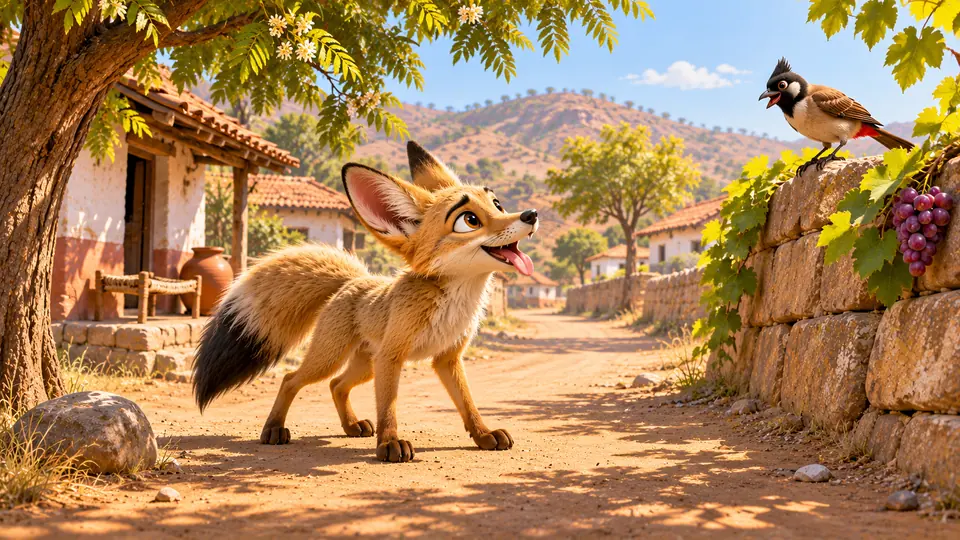
Finn crouched low, wiggled his back legs, and sprang into the air. Up he went, as high as he could go, and down he came again with a soft thump. His nose had not even touched the lowest grape. "That was only a warm-up," he told Tilly, though she had not asked. He shook out his paws and looked at the grapes again.
This time Finn walked far back down the lane. He took a deep breath, ran as fast as his legs would carry him, and leapt. For a moment he felt like he was flying. Then the wall came closer, the grapes stayed just as far away, and he landed on his side in a cloud of dust. Tilly tilted her head. "Are you all right?" she asked. "Perfectly fine," said Finn, spitting out a little dirt.
Finn was not ready to give up. He found a flat stone by the road and pushed it with his nose, huffing and puffing, until it sat right under the vine. He climbed onto it, stretched up on his back legs, and jumped once more. The stone wobbled, his paws slipped, and he tumbled backward into the dry grass. The grapes swayed gently above him, as if nothing had happened.

Tilly hopped down to a lower leaf. "I could try to help," she said kindly. "Maybe if I peck at the stem, a few will fall." Finn stood up very straight. He brushed the dust from his fur and lifted his nose in the air. "No, thank you," he said. "I can see now that those grapes are not even ripe. They are sour. Anyone can tell. I would not eat them if you paid me."
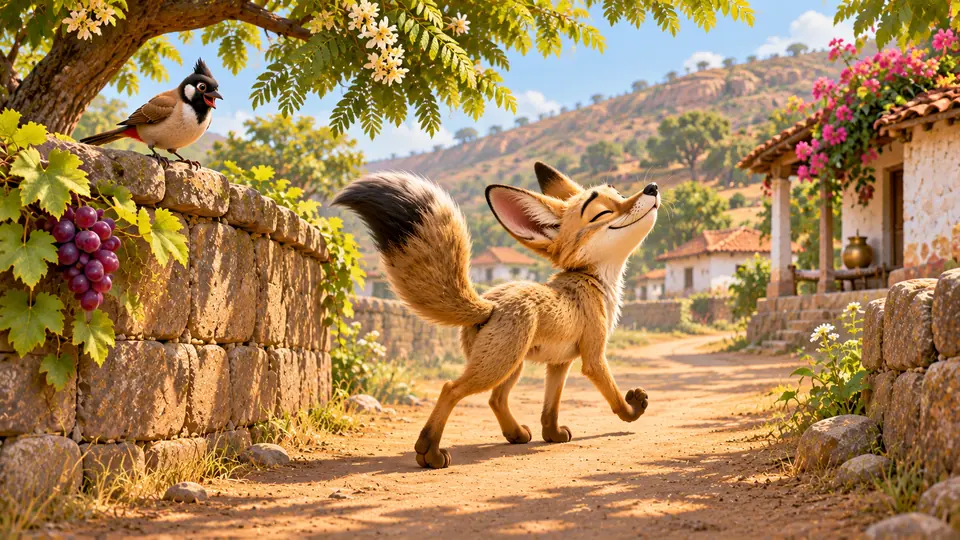
Tilly looked at the grapes, then at Finn, then at the grapes again. She hopped up and gave one a small peck. "Mmm," she sang out. "Finn, they are as sweet as jaggery!" Finn's ears went pink. He turned around and began to walk away with his tail held high. "Sour," he muttered. "Sour, sour, sour." But his steps grew slower and slower, until he stopped in the shade of the neem tree and sat down.
Tilly fluttered down and settled on a low branch above him. For a while neither of them said anything. Then Finn let out a long sigh. "They are not sour," he said quietly. "I wanted them so much, and I could not reach them, and I felt silly. It was easier to say I did not want them at all." Tilly nodded. "It is all right to be disappointed," she said.
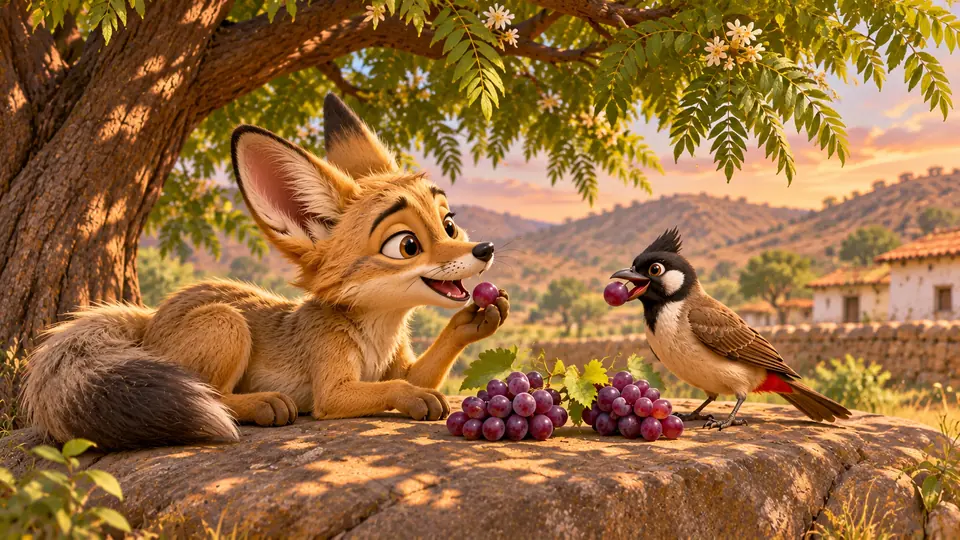
Finn felt lighter, as if he had put down something heavy. Tilly sang him a cool little song while the sun slid toward the hills. When the evening breeze came, it shook the vine, and two ripe grapes dropped into the grass by the wall. Tilly laughed, and Finn laughed too. He ate one, slowly, and left the other for her. It was sweet, just as Tilly had said.
Meet Finn and Tilly
Finn is a quick, proud young fox who hates to look foolish. When the grapes stay out of reach, he tries to save face by saying they were sour all along. Tilly is a small, cheerful bulbul bird who sings, watches and notices things. She never laughs at Finn, and her gentle honesty helps him tell the truth about how he really feels.
The moral
When we cannot get something we wanted, it is tempting to pretend we never wanted it in the first place. That is where the phrase "sour grapes" comes from, and in Hindi people say "अंगूर खट्टे हैं" (the grapes are sour). Finn's excuse did not make the grapes sour or make him feel better. What helped was saying the truth: "I wanted them, and I am disappointed." Being honest about our feelings is braver than hiding them.
The story in 10 lines
Show the 10 linesHide the 10 lines
- On a hot afternoon, Finn the fox was hungry and thirsty as he walked past a village wall.
- A grapevine climbed over the wall, and a bunch of ripe purple grapes hung from the top.
- Finn wanted the grapes very much, so he jumped as high as he could.
- His nose did not even touch the lowest grape.
- He took a running start and jumped again, but he still could not reach them.
- He pushed a stone under the vine and jumped from it, but he only tumbled into the dust.
- Tilly the bird watched from the vine and asked if he needed help.
- Finn brushed off his fur and said the grapes were sour anyway, and he did not want them.
- Tilly pecked a grape and called down that it was very sweet.
- Finn admitted that he had wanted the grapes and was sad, and when the evening breeze shook two grapes down, he shared them with Tilly.
Story writing: hints for class 1 to 5
Use these hints to write The Fox and the Grapes story in your own words: a hot summer day – a fox is hungry and thirsty – he sees a bunch of ripe grapes hanging high on a vine – his mouth waters – he jumps to reach them but cannot – he runs and jumps again, and fails again – he tries many times and grows tired – at last he gives up and walks away – he says, "The grapes are sour anyway."
Title: The Fox and the Grapes (also called Sour Grapes). Moral: It is easy to say we never wanted something we could not get.
Writing tip: the classic story ends when the fox walks away calling the grapes sour. In our retelling, Finn later admits the grapes were sweet and that he felt disappointed. You can add this as a happy ending to show that being honest about our feelings is brave.
Questions to discuss
Talk about a time you really wanted something and could not have it, and what you said or did afterward. Ask why Finn said the grapes were sour, how he felt when Tilly said they were sweet, and why he felt lighter after telling the truth.
What does the phrase sour grapes mean?
“Sour grapes” means pretending something is not good, or that you never wanted it, just because you could not get it. The phrase comes from this fable, and the Hindi saying “अंगूर खट्टे हैं” means the same thing.
How did Finn try to reach the grapes?
First he jumped from where he stood, then he took a running start, and then he pushed a flat stone under the vine and jumped from it. None of these worked.
Why did Finn say the grapes were sour?
Finn felt silly after failing so many times, so he said the grapes were sour to make it seem as if he had never wanted them.
What happened at the end of the story?
Finn admitted to Tilly that the grapes were not sour and that he was disappointed. In the evening breeze two grapes fell, and he shared them with Tilly.
Is The Fox and the Grapes an Aesop's fable?
Yes. It is a traditional fable attributed to Aesop, the storyteller of ancient Greece, retold here in modern, family-friendly English with an Indian village setting.