A QUICK SUMMARY
The story in 5 lines
- A poor Brahmin named Haridatt was given a clay pot full of barley flour.
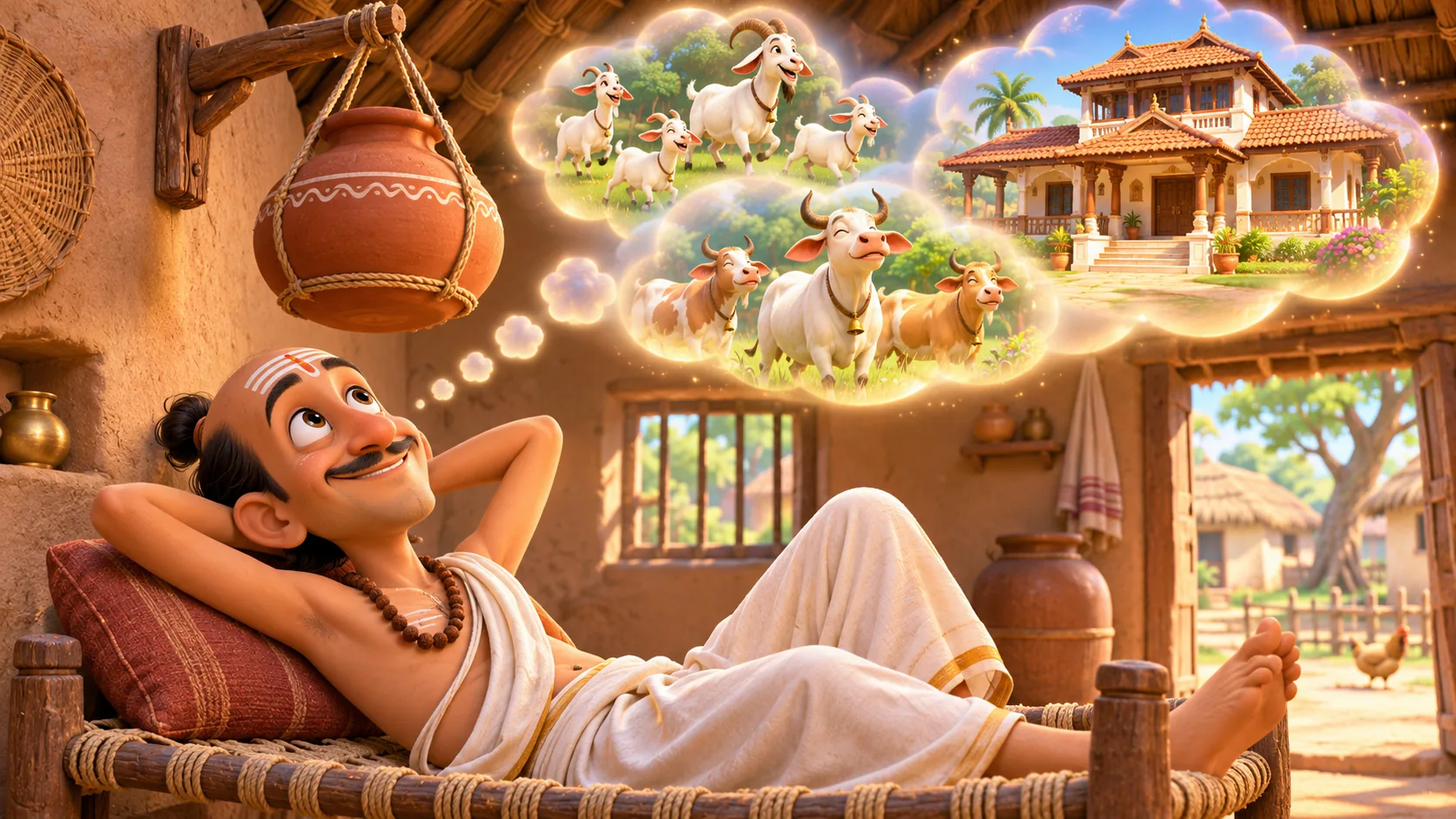
- He hung it above his bed and daydreamed of turning it into goats, cows, horses and a big house.
- In his daydream he kicked a stable door, but his real foot kicked the pot and broke it.
- The flour spilled everywhere, but Haridatt swept up the clean flour and saved it in a bowl.
- The next morning he baked small breads from the saved flour and sold two at the market.
Moral: Plans are good, but do not count on riches you have not earned yet; begin with the first real step.
Source: From the Panchatantra, Book 5: Aparikshitakarakam (Ill-Considered Action). Who wrote the Panchatantra?
Retold by Fable Stories. How we write, illustrate and translate our stories.
Story origin: An original modern-English Fable Stories adaptation of the traditional Panchatantra tale of the daydreamer and his pot of flour.
The Brahmin's Dream Story in English
In a small village lived a poor Brahmin named Haridatt. He lived alone in a hut with one room, one bed, and one broom. Most days he had just enough to eat, and some days not quite enough.
One morning a kind family gave him a clay pot filled to the brim with barley flour. Haridatt had never owned so much food at once. He carried the pot home in both arms, as carefully as if it were a sleeping baby.
"I must keep it safe," he said. So he tied a string around the pot and hung it from a peg in the wall, just above the foot of his bed. Then he lay down, folded his hands under his head, and looked up at it. The pot swung gently. Haridatt began to think.
"If a famine comes," he said to himself, "flour will be worth a great deal. I will sell this pot for a good price. With the money I will buy two goats. Goats have kids, and those kids will have kids. Soon I will have a whole herd."
He smiled at the ceiling. "I will trade the herd for cows. The cows will give milk and calves, and I will trade them for buffaloes. Then I will trade the buffaloes for horses. Fine, fast horses. People will pay well for them, and I will build a big house with four rooms, a stable, and a courtyard."
By now Haridatt could see it all as clearly as the pot above him. "A man with such a house will surely marry," he went on. "We will have a little son. One day he will crawl across the courtyard, straight toward the horses. I will be busy reading, so I will call out, 'Somebody mind the child!' But everyone will be busy, and nobody will listen."
Haridatt frowned on his bed, truly annoyed at a household that did not exist. "Then I will have to get up myself," he grumbled. "I will march to the stable, and I will be so cross that I will give that stable door a great kick. Like this!" And his foot shot out.
It did not find a stable door. It found the clay pot. Crack! The pot split in two, and the barley flour poured down over his legs, his chest, his beard, his bed, and the floor. Haridatt sat up, white from head to toe. The goats were gone. The cows, the buffaloes, the horses, and the big house were gone. Only half a broken pot swung on its string.
For a moment he said nothing. Then he began to laugh, a little sadly. "I owned a stable before I owned a single goat," he said, "and I have kicked away my supper to prove it." He took his broom, swept up every bit of flour that was still clean, and saved it in a bowl.
The next morning Haridatt did not lie down to plan. He lit his fire, mixed the saved flour with water, and baked four small flat breads. He ate two and carried two to the market, where he sold them for a copper coin. It was not a herd of horses. But it was real, and it was his, and it was a beginning.
Meet Haridatt
Haridatt is poor, hopeful, and full of ideas. Nothing is wrong with his wish for a better life, and each step of his plan almost makes sense. His trouble is that he enjoys the end of the plan so much that he forgets he has not yet taken the first step.
The moral
Plans are good, and so are big dreams. But a dream is not the same as a thing you have earned. Haridatt counted goats, cows, and horses he did not have, and lost the flour he did have. The wiser way is to do one small real thing today, and let the plan grow from there.
The story in 10 lines
Show the 10 linesHide the 10 lines
- A poor Brahmin named Haridatt lived alone in a small hut in a village.
- One morning a kind family gave him a clay pot full of barley flour.
- He hung the pot from a peg above the foot of his bed and lay down to look at it.
- Haridatt began to dream that he would sell the flour and buy two goats, which would grow into a whole herd.
- He imagined trading the goats for cows, the cows for buffaloes, and the buffaloes for fine horses.
- With the money he would build a big house, get married and have a little son.
- In his dream his son crawled toward the horses, and nobody listened when Haridatt called for help.
- Feeling cross, he imagined kicking the stable door, but his real foot shot out and broke the pot.
- The flour poured all over him, but he laughed a little sadly and swept up the flour that was still clean.
- The next morning he baked four small breads from the saved flour, ate two and sold two at the market.
Questions to discuss
Follow Haridatt's plan step by step and ask where it stopped being a plan and became a daydream. Talk about what he did differently the next morning, and why two small breads were worth more than an imaginary stable. Invite children to name one big wish and the very first small step toward it.
How does the pot of flour break?
Lost in his daydream, Haridatt imagines kicking a stable door in annoyance. His real foot kicks out and hits the pot hanging above his bed, so it breaks and the flour pours over him.
Is The Brahmin's Dream a Panchatantra story?
Yes. It is a traditional Panchatantra tale from Book 5, Aparikshitakarakam (Ill-Considered Action), retold here in modern, family-friendly English.
BRING THE ADVENTURE TO PAPER
Free coloring pages
Color Haridatt's pot, his quiet afternoon, and the dreams floating above him. Download in A4 or US Letter.
3 pages per PDF · A4: 3.6 MB · US Letter: 3.6 MB · Free, no sign-up