Every story on Fable Stories in five short lines, with its picture and its moral. Read one aloud in a minute, use it for a class 1 to 5 story writing task, then open the full story, the 10-line version or the animated video.
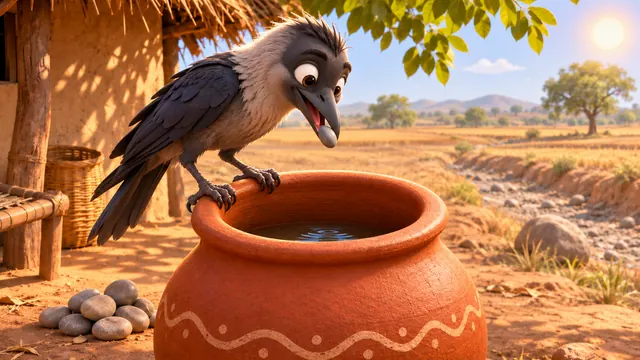
On a hot summer day, Jet the crow searched everywhere for water. He found a clay pot with only a little water at the very bottom. His beak could not reach the water, and the pot was too heavy to tip over. Jet picked up pebbles and dropped them into the pot one by one. The water rose to the top, and Jet drank his fill and flew happily home.
Moral: Where there is a will, there is a way: calm thinking and patience can solve a problem that strength alone cannot.
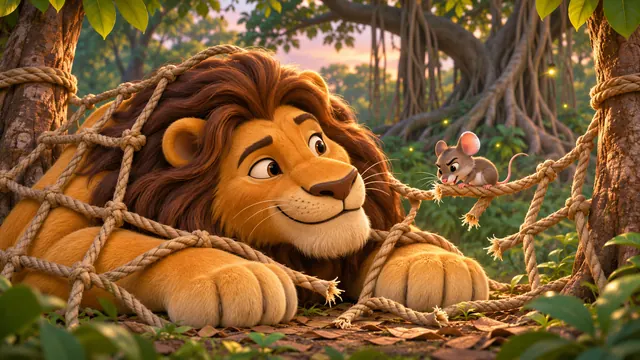
Leo the lion caught a little mouse named Pip who had run across his paw. Pip promised to help Leo one day, and Leo laughed but let him go. Later, Leo was caught in a hunters' rope net and could not get free. Pip heard his roar and nibbled through the ropes until Leo could climb out. Leo thanked Pip, and the lion and the mouse became the best of friends.
Moral: No act of kindness is ever wasted, and even the smallest friend can help the mightiest.
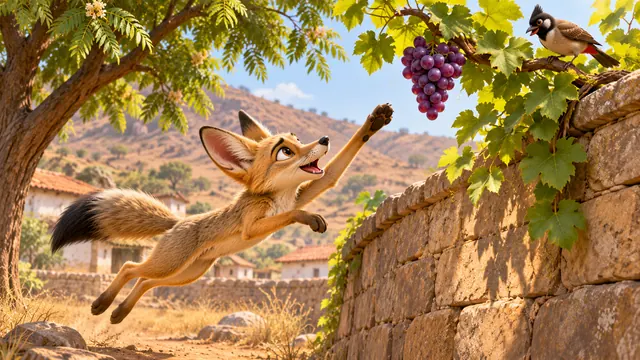
On a hot afternoon, Finn the fox saw ripe grapes hanging from a vine on a village wall. He jumped again and again, and even tried jumping from a stone, but he could not reach them. Finn walked away saying the grapes were sour anyway. Tilly the bird tasted one and told him the grapes were sweet. Finn admitted that he had really wanted the grapes, and when the breeze shook two down, he shared them with Tilly.
Moral: It is easy to pretend we never wanted what we could not get, but it is braver and kinder to ourselves to be honest about feeling disappointed.
Dash the fast hare often laughed at Toby the slow tortoise. Toby asked Dash to race him to the big banyan tree, and Olive the old owl started the race. Dash ran far ahead and then fell asleep in the shade of a mango orchard. Toby kept walking slowly and steadily and passed the sleeping hare. Toby reached the banyan tree first, and Dash woke up too late, congratulated him and said sorry.
Moral: Slow and steady wins the race: keep going without giving up, and never boast about how good you are.
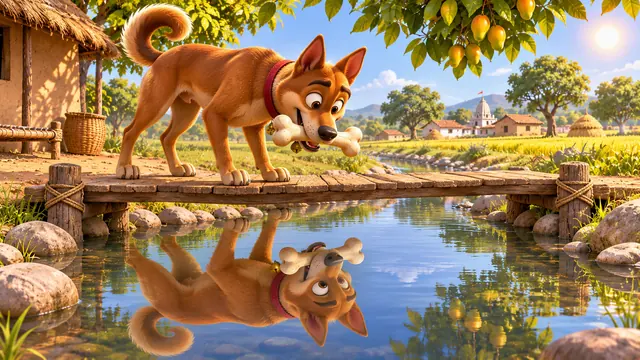
Moti the village dog got a big bone, but he would not share it with anyone. He crossed a narrow bridge over a stream to eat it all by himself. In the water he saw a dog with a bone that looked even bigger than his. Moti barked to grab it, and his own bone fell into the stream. It was only his reflection, and greedy Moti lost his bone.
Moral: Greed can make us lose even what we already have, so be thankful for what you have and share it.
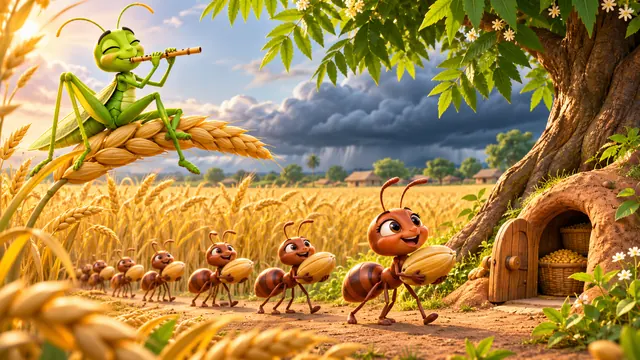
All summer Ally the ant and her colony stored grain while Skip the grasshopper sang and played. Ally warned Skip that the monsoon was coming, but he only laughed. When the heavy rains came, Skip had no food and nowhere dry to stay. Ally and the ants took him in and shared their grain with him. Skip cheered the colony with his music all through the rains and promised to help gather food next summer.
Moral: Work and get ready today for what you will need tomorrow, and when others are in need, share kindly.
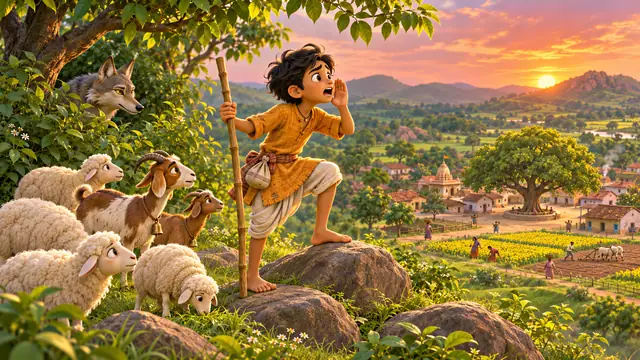
Sam looked after the village sheep and goats on a hill and often felt bored. Twice he shouted “Wolf!” as a joke, and twice the villagers ran up and found nothing. Then a real wolf came, and Sam shouted for help again. This time nobody believed him, and the wolf carried off two sheep. Sam understood why nobody had come and promised to always tell the truth.
Moral: If you tell lies again and again, people stop trusting you, and they may not believe you even when you tell the truth.
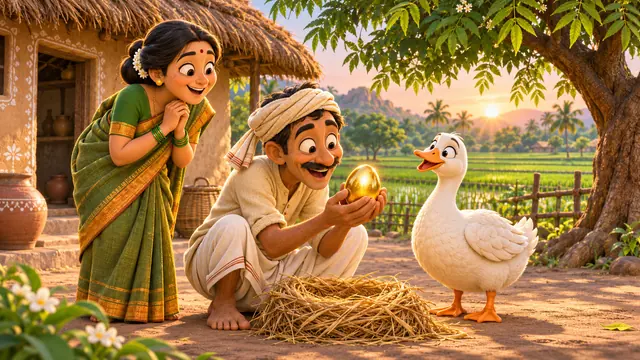
Tom, a poor farmer, had a goose named Goldie who laid one golden egg every morning. By selling the eggs, Tom and his wife Meg soon became rich. Tom grew impatient and thought Goldie must be full of gold inside. He cut the goose open, but she was just like any other goose and there was no gold. The golden eggs stopped forever, and Tom was left with his savings and a heart full of regret.
Moral: Greed can destroy the very thing that brings us good, so be patient and grateful for what you have.
Gale the North Wind and Sunny the Sun argued about who was stronger. Gale demanded a contest, and Sunny said the winner would be whoever made Jack the traveler take off his cloak. Gale blew harder and harder, but Jack only wrapped his cloak tighter. Then Sunny shone gently and warmly, and Jack took off his cloak and rested in the shade. Sunny won the contest, and Gale admitted that the Sun was stronger.
Moral: Gentleness and kind persuasion can succeed where force and bullying fail.
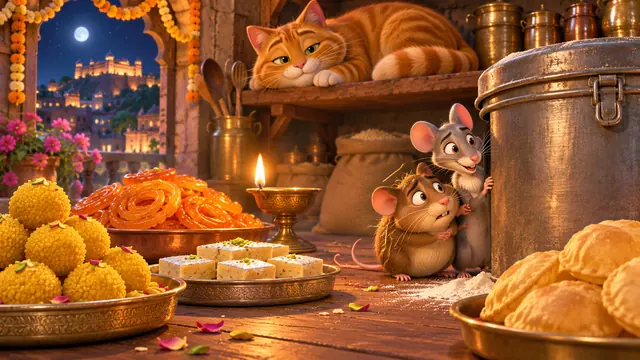
Fred the country mouse shared his simple grains and chana with his cousin Max. Max did not enjoy the plain food and took Fred to his big house in the city. The kitchen was full of laddoos and jalebis left over from a wedding feast. But the cook, a cat and a barking dog kept making them run and hide. Fred thanked Max, went home to his haystack and slept peacefully.
Moral: A simple life in peace and safety is better than a rich life full of fear.
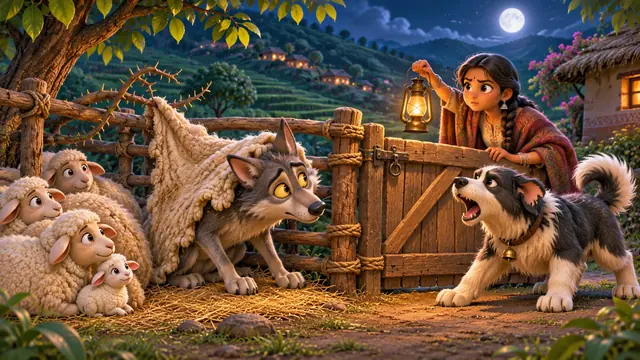
A hungry wolf put on an old sheepskin and slipped into Anna's flock. Scout the sheepdog growled at him, but Anna thought he was only a sheep and shut the flock in the pen for the night. At night the sheepskin slipped off as the wolf crept toward Fluff the little lamb. Fluff bleated, Scout barked, and Anna found the wolf trapped in the pen he had chosen. Anna opened the back gate, Scout chased the wolf far into the hills, and the wolf never came back.
Moral: Appearances can fool us, so judge others by what they do, and remember that a trick meant to harm others can end up trapping the trickster.
Ranga the monkey shared sweet jamuns with Kavi the crocodile, and they became friends. Kavi's greedy wife wanted to eat the monkey's heart. Kavi carried Ranga across the river and told him the truth in the deepest water. Ranga said he had left his heart in the jamun tree, so Kavi swam back to the tree. Ranga leapt to safety on a high branch, and Kavi went home alone.
Moral: A quick mind can carry you through troubled waters.
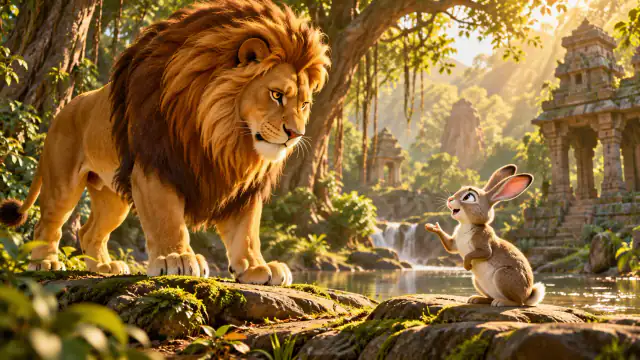
Bhairav the lion hunted so much that the animals agreed to send him one animal each day. When it was Chiku the rabbit's turn, he came late on purpose. Chiku told the angry lion that another lion said he was the king of the forest. He led Bhairav to an old well, where the lion saw his own reflection in the water. Bhairav jumped in to fight the other lion, could not climb out, and the forest was free.
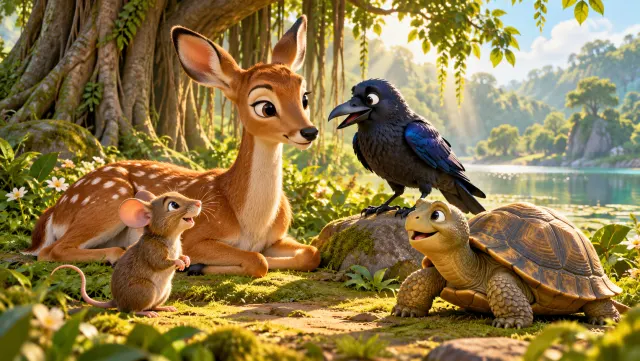
Chitra the deer, Kaku the crow, Hira the mouse and Dhruv the tortoise were close friends. When Chitra was caught in a hunter's net, Kaku carried Hira there, and Hira chewed through the ropes. Then the hunter caught slow Dhruv and put him in a cloth bag. Chitra pretended to be an easy prize, so the hunter put down the bag and went after her. Hira cut Dhruv free, Chitra jumped up and ran, and the hunter lost both his prizes.
Moral: Friends do not need the same strengths; when each person contributes what they can, even a difficult problem becomes possible to solve.
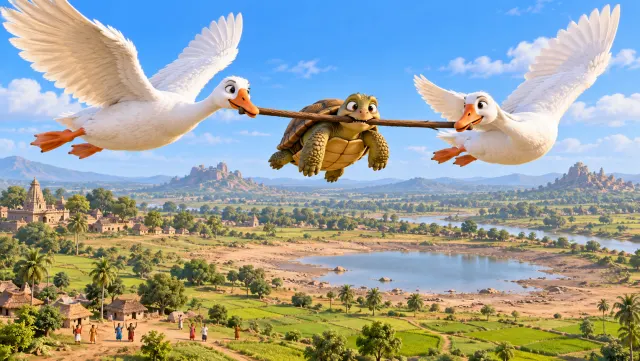
Kambu the talkative tortoise needed to leave his drying lake with his friends, the geese Arun and Varun. The geese carried him on a stick, and he had to keep his mouth closed. When villagers laughed at him, Kambu opened his mouth to answer and fell into a cart of soft cotton. The next morning they tried again, and this time Kambu kept his mouth firmly closed. They reached the new lake safely, and Kambu thanked his friends for their patience.
Moral: Wisdom is not only knowing what to say; it is knowing when silence protects what matters most.
Madan the hunter caught Sindhuka, a bird whose fallen feathers turned into gold. He took the bird to King Veerendra, but the minister Devraj laughed and said it was impossible. Devraj refused to test the bird, so the king set Sindhuka free. A feather fell and turned to gold in front of everyone, but Sindhuka was already flying away. Sindhuka escaped to the mountains, and the king kept the golden feather in his treasury.
Moral: Do not dismiss something merely because it seems impossible. Test the truth before you judge it.
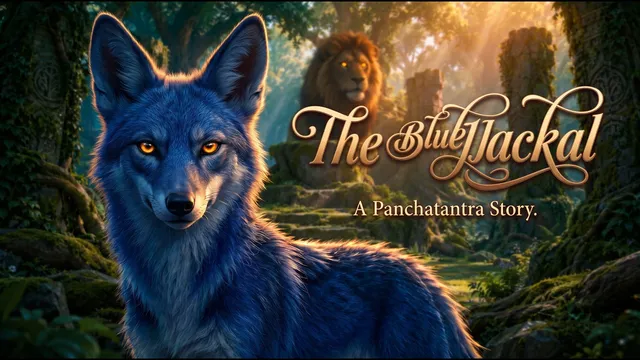
Chandra the jackal fell into a barrel of blue dye while running from village dogs. The forest animals feared his blue fur, so he told them he was a king named Neelambar. He lived like a king and kept the other jackals away so they would not give away his secret. One night he heard jackals howling and howled back, and the animals knew he was only a jackal. They drove him away, and Chandra learned that respect built on a lie cannot last.
Moral: Pretending to be something you are not may bring temporary success, but your true nature eventually reveals itself.
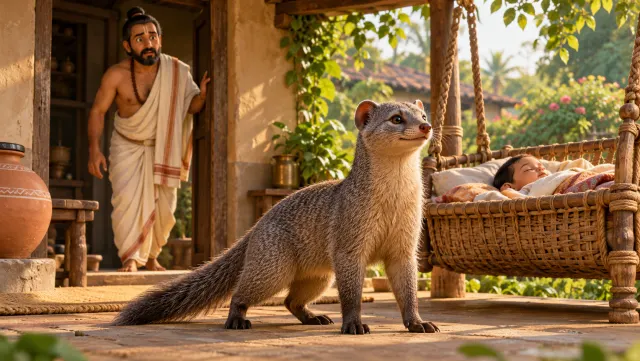
Somdev and Anaya raised a loyal mongoose named Veer beside their baby son. While Somdev was away, Veer fought off a cobra to keep the baby safe. When Somdev saw a dark stain on Veer's mouth, he feared Veer had hurt the baby. He paused and checked the cradle first, and he found his son sleeping safely. Somdev thanked Veer, and the family made him the guardian of their home.
Moral: A frightening first impression is not the whole truth; pause, examine the evidence, and understand before you act.
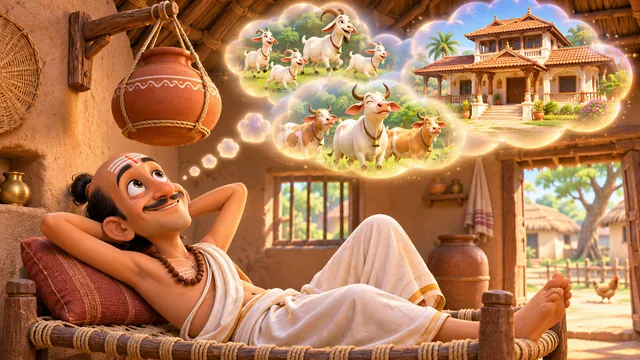
A poor Brahmin named Haridatt was given a clay pot full of barley flour. He hung it above his bed and daydreamed of turning it into goats, cows, horses and a big house. In his daydream he kicked a stable door, but his real foot kicked the pot and broke it. The flour spilled everywhere, but Haridatt swept up the clean flour and saved it in a bowl. The next morning he baked small breads from the saved flour and sold two at the market.
Moral: Plans are good, but do not count on riches you have not earned yet; begin with the first real step.
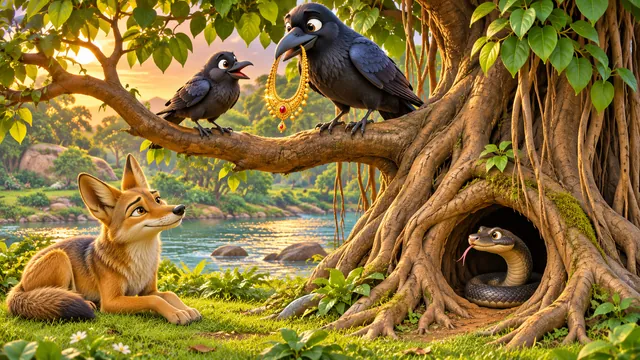
Megha and Shyam were two crows whose eggs were taken every season by a serpent named Kalnag. Their friend Chatur the jackal told them to use a clever plan instead of fighting. Megha took a gold necklace and led the palace guards to the serpent's hollow. The guards found Kalnag while looking for the necklace and chased him far away. Kalnag never came back, and the crows raised their chicks in peace.
Moral: When you cannot match an opponent's strength, a careful plan can do what force cannot.
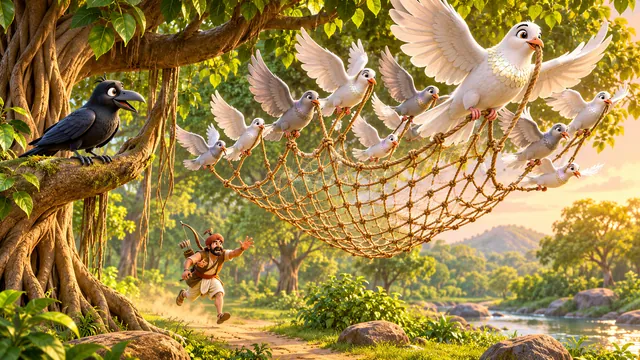
Madan the bird hunter caught a flock of doves and their king, Chitragreev, under a hidden net. Chitragreev told the doves to fly up together on the count of three. The whole flock lifted the net into the sky and escaped from the hunter. Chitragreev led the flock to his old friend Hira the mouse, who had sharp teeth. Hira gnawed through the cords, freeing the other doves first and Chitragreev last, as the king asked.
Moral: Unity is strength: together the small can do what none can do alone, and a good leader thinks of others first.
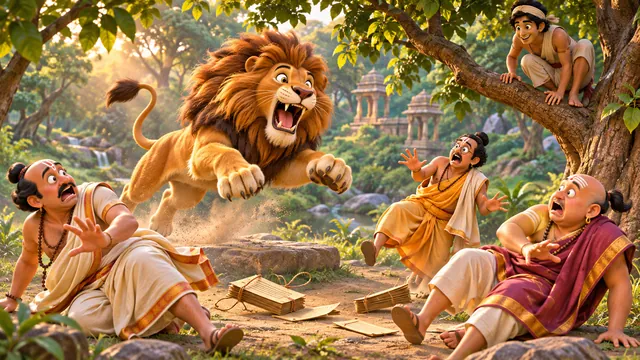
Three scholars, Vidyadhar, Gyanesh and Shastri, traveled with their sensible friend Subuddhi. In a forest they used their learning to rebuild a lion from a heap of bones. Subuddhi warned them to stop, and when they would not listen, he climbed a tree. Shastri brought the lion to life, and the three scholars had to run and hide. When the lion left, they crept back and told Subuddhi he was the wisest of them all.
Moral: Knowledge without common sense is dangerous; think about what will happen before you use what you know.
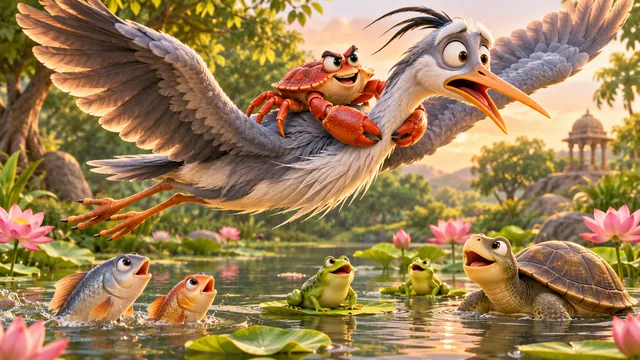
An old heron named Bakul told the fish of his pond that it would soon dry up. He offered to fly them to a faraway lake, but he was really tricking them. A watchful crab named Karka asked to go and saw that there was no lake at all. Karka held the heron's neck tightly and made him fly back to the pond. Karka told everyone the truth, and Bakul flew away and never returned.
Moral: Do not trust sweet words from someone who gains by your trust; look for proof, and stay alert.
A hungry jackal named Jambu heard a loud booming sound in an empty field. He was afraid it was a giant beast, but he decided to go and look. He found an old war drum under a tree, where a branch blown by the wind kept hitting it and making the boom. He hoped the big drum was full of food, but when he chewed through its skin, it was empty inside. Jambu walked on, found ripe berries and wild melons, and ate until he was full.
Moral: Do not be frightened by a noise alone; find out what is really there. Big and loud does not mean strong or full.
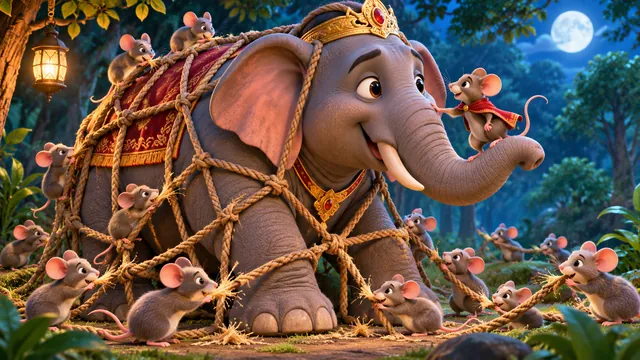
Mushik the mouse asked Gajraj, the elephant king, to stop his herd from trampling the mouse homes. Gajraj laughed at the promise of help from a mouse, but he kindly led his herd another way. Many seasons later, hunters caught the elephants in strong rope nets. Gajraj sent for Mushik, and thousands of mice gnawed through the ropes all night. Before sunrise the herd walked free, and Gajraj thanked the little mouse who had kept his promise.
Moral: No friend is too small; kindness given freely comes back when you need it most.
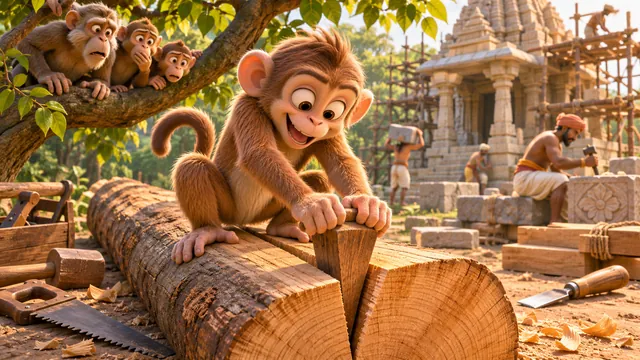
A curious young monkey named Chapal played where carpenters were building a temple. An old monkey warned him not to touch the carpenters' tools, but he did not listen. Chapal pulled a wedge out of a half-cut log, and the log snapped shut on his tail. When the carpenters came back, one of them kindly opened the log with an iron bar and freed him. Chapal's tail was sore for days, and after that he asked the elders before touching anything new.
Moral: Do not meddle in things that are not your business and that you do not understand.
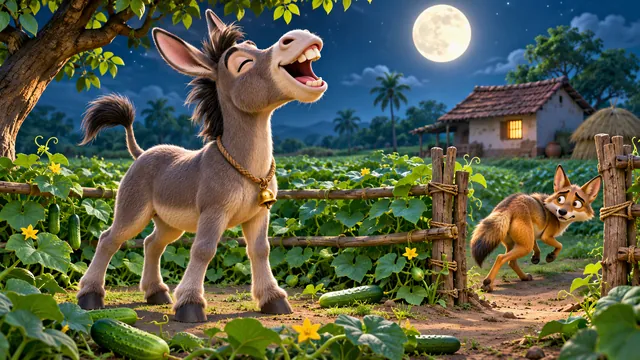
Bholu the donkey and Phurti the jackal secretly ate cucumbers in a farmer's field every night. One moonlit night Bholu wanted to sing, but Phurti warned him to stay quiet. Bholu would not listen, and his loud "Hee-haw!" woke the farmer and his watchmen. They chased him out and tied a heavy wooden block around his neck. Bholu found Phurti waiting under a tree and admitted that his friend had been right.
Moral: There is a right time and place for everything; listen when a good friend warns you.
Three fish lived in a pond: Agam the planner, Pratyu the quick thinker and Bhagya who trusted luck. Agam heard that fishermen were coming and left for the river that night. The next morning the fishermen caught Pratyu and Bhagya in a net. Pratyu escaped by pretending to be dead, and Bhagya escaped only because a fisherman slipped. All three fish met again in the river, and from then on Bhagya listened when Agam warned of trouble.
Moral: Plan ahead when you see trouble coming; quick thinking can save you, but waiting for luck is the riskiest choice of all.
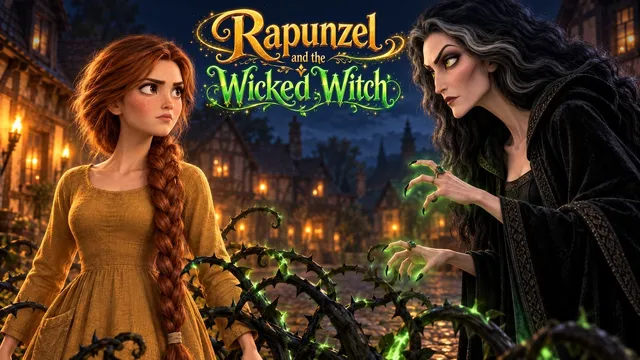
The witch Gothel stole a baby princess, named her Rapunzel and locked her in a tall tower. When she was eighteen, Rapunzel cut off her long braid and climbed down it to escape. Prince Leo showed her the wonders of the world, and she used the North Star to lead two lost children home. Gothel's fear magic attacked the village, but Rapunzel and the villagers stood up to her, and the thorns crumbled. Rapunzel's crooked star pendant led her home to her parents, the king and queen.
Moral: Take responsibility for your own life instead of living by cruel or fearful rules. Curiosity is a spark no rule can put out, and goodness always wins over evil.
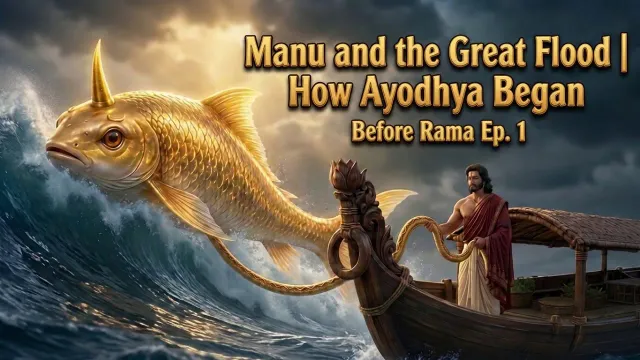
King Satyavrata saved a tiny fish that was afraid of being eaten by bigger fish. The fish kept growing until even the river was too small, and it said it was Lord Vishnu as Matsya. Matsya warned of a great flood in seven days, so the king gathered seeds, plants and gentle creatures. When the flood came, Matsya pulled the king's boat through the storm until a new dawn began. Satyavrata was later reborn as Manu, and tradition tells that Manu founded the city of Ayodhya.
Moral: Kindness to the smallest creature is never wasted; a compassionate heart that listens and acts with courage can carry others safely through the greatest storm.
Each short story keeps the beginning, the problem and the ending of the full tale in five simple sentences, so a young child can follow it and retell it. Read it aloud first, then ask your child what happened next or how they would end it.
For school story writing, the short version works as a model answer: a title, a few clear sentences in the past tense, and the moral on its own line. Eight of the stories also have story writing hints for class 1 to 5 on their full pages, gathered with a worked example on our story writing page.
When your child wants more, every story links to a longer retelling, a 10-line version and questions and answers, and many have a free animated video and coloring pages.