A QUICK SUMMARY
The story in 5 lines
- An old heron named Bakul told the fish of his pond that it would soon dry up.
- He offered to fly them to a faraway lake, but he was really tricking them.
- A watchful crab named Karka asked to go and saw that there was no lake at all.
- Karka held the heron's neck tightly and made him fly back to the pond.
- Karka told everyone the truth, and Bakul flew away and never returned.
Moral: Do not trust sweet words from someone who gains by your trust; look for proof, and stay alert.
Source: From the Panchatantra, Book 1: Mitrabheda (The Loss of Friends). Who wrote the Panchatantra?
Retold by Fable Stories. How we write, illustrate and translate our stories.
Story origin: An original modern-English Fable Stories adaptation of the traditional Panchatantra tale also told as The Crane and the Crab.
The Heron and the Crab Story in English
Beside a green pond full of lotus flowers lived an old heron named Bakul. When he was young, he could catch a fish in the blink of an eye. Now his legs were stiff and his eyes were tired. The fish darted away long before his beak reached the water.
"I am too slow to catch them," Bakul thought. "So I must make them come to me." The next morning he stood at the edge of the pond on one leg, with his head hanging low. He did not chase a single fish. He only sighed, loudly, again and again.
The fish grew curious and swam closer. A crab named Karka, who lived under a stone near the bank, crept out to listen too. "Why are you so sad, Uncle Heron?" asked a small fish. Bakul sighed once more. "I am sad for you, little ones. I have heard that no rain will come this year. This pond will soon dry up, and I cannot bear to think of it."
The fish were frightened. "What can we do?" they cried. "There is a deep lake beyond the hill," said Bakul softly. "It never dries. I am old, but I can still fly. I could carry you there, one by one, in my beak. It is the least I can do for my neighbors."
The fish thanked him again and again. Nobody asked who had told him about the rain. Nobody asked to see the lake first. Every morning Bakul picked up one fish and flew over the hill, and every afternoon he came back alone, looking strangely well fed. "Your friends are so happy there," he would say.
Karka watched all of this from his stone. The pond was as full as ever, and the heron grew plumper each day. "That is odd," thought Karka. So one morning he called out, "Uncle Heron, please take me to the lake today." Bakul was pleased to try something new. "Climb onto my back," he said, "and hold on to my neck."
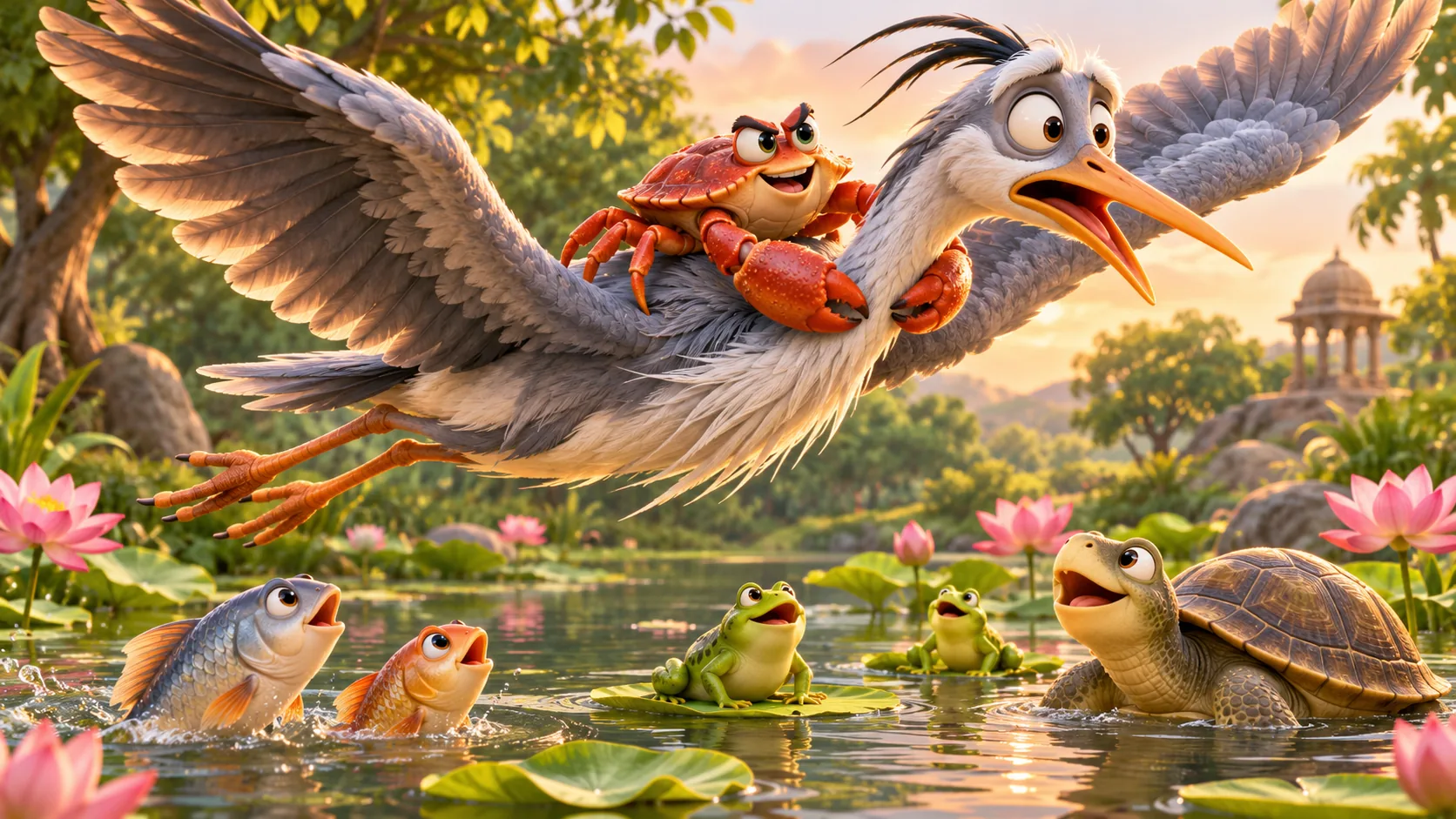
Up they flew, over the reeds and over the hill. Karka looked down with his sharp little eyes. "Where is the lake?" he asked. There was no water anywhere. There was only a wide, bare rock in the sun, and Bakul was gliding straight toward it. At once Karka understood. The fish had never reached any lake. The heron had been bringing them here for himself.
Karka did not shout, and he did not let go. He closed his strong claws around the heron's thin neck. "Turn around," he said firmly. "Fly straight back to the pond, or I will squeeze harder." Bakul gasped and flapped. "Please, not so tight!" he croaked. He turned in the air and flew back the way he had come.
Bakul landed at the edge of the pond, and Karka slid safely into the shallow water. "Listen, everyone," he called. "There is no lake beyond the hill. I saw only a bare rock. The heron lied to us so that we would come to him." The fish stared at the heron. Then they splashed and slapped the water with their tails, and the frogs and turtles joined in with all the noise they could make.
With nowhere to hide and nothing left to say, Bakul flapped away over the trees and never returned. The rains came that year, as they always had. And from then on, whenever a stranger brought alarming news and a kind offer together, the fish of the pond remembered Karka and asked one simple question first: "How do you know?"
Meet Bakul and Karka
Bakul the heron is old and clever, but he uses his cleverness to deceive the neighbors who trust him. Karka the crab is quiet and watchful. He notices what does not fit, checks the heron's story with his own eyes, and stays calm enough to act when he learns the truth.
The moral
Kind words are not the same as kind actions. The fish believed Bakul because he sounded caring, and they never asked how he knew or what he would gain. Before you trust a surprising offer, look for proof, notice who benefits, and stay alert the way Karka did.
The story in 10 lines
Show the 10 linesHide the 10 lines
- An old heron named Bakul lived beside a lotus pond with many fish and a crab named Karka.
- Bakul had grown too slow to catch fish, so he thought of a trick.
- He stood sadly by the pond and told the fish that no rain would come and the pond would dry up.
- He offered to carry the fish, one by one, to a deep lake beyond the hill.
- The fish thanked him, and nobody asked how he knew or asked to see the lake first.
- Each day Bakul flew off with one fish and came back alone, looking well fed.
- Karka noticed that the pond was still full and the heron was getting plumper, so he asked to go next.
- From the heron's back, Karka saw that there was no lake at all, only a bare rock.
- Karka held the heron's neck tightly and made him fly straight back to the pond.
- Karka told everyone the truth, and Bakul flew away and never returned.
Questions to discuss
Talk about the clues Karka noticed before he asked to go to the lake. Ask your child what questions the fish could have asked Bakul at the start, and whom they can check with when someone they do not know well makes a big promise.
How does the crab discover that the heron is lying?
Karka asks to be carried to the lake and looks down from the air. He sees no lake at all, only a bare rock, and understands that the fish never reached any lake.
Is The Heron and the Crab a Panchatantra story?
Yes. It is a traditional Panchatantra tale from Book 1, Mitrabheda (The Loss of Friends), retold here in modern, family-friendly English.
BRING THE ADVENTURE TO PAPER
Free coloring pages
Meet Karka and Bakul, then color their journey above a lively lotus pond. Download in A4 or US Letter.
3 pages per PDF · A4: 3.8 MB · US Letter: 3.8 MB · Free, no sign-up