A QUICK SUMMARY
The story in 5 lines
- Tom, a poor farmer, had a goose named Goldie who laid one golden egg every morning.
- By selling the eggs, Tom and his wife Meg soon became rich.
- Tom grew impatient and thought Goldie must be full of gold inside.
- He cut the goose open, but she was just like any other goose and there was no gold.
- The golden eggs stopped forever, and Tom was left with his savings and a heart full of regret.
Moral: Greed can destroy the very thing that brings us good, so be patient and grateful for what you have.
Source: From Aesop's Fables (Perry Index 87)
Retold by Fable Stories. How we write, illustrate and translate our stories.
Story origin: An original modern-English Fable Stories adaptation of Aesop's fable about a farmer whose goose lays one golden egg a day, and who, wanting all the gold at once, destroys the goose and loses the golden eggs for good.
The Goose that Laid the Golden Eggs Story in English
In a small village among green rice fields, under the shade of an old neem tree, lived a poor farmer named Tom and his wife, Meg. Their hut was made of mud, their roof leaked every monsoon, and some nights there was only one roti to share between them. Still, Meg always smiled and said, "We have each other, and we have our little field. That is something." Tom nodded, but in his heart he often wished for more.
One market day, Tom sold a sack of lentils and had a few coins left over. At the edge of the market an old woman was selling a single white goose with bright orange feet. "She is a good bird," the old woman said. "Look after her well." Tom bought the goose and carried her home under his arm. Meg laughed with delight and named her Goldie. They made her a soft nest of straw in the corner of the yard.
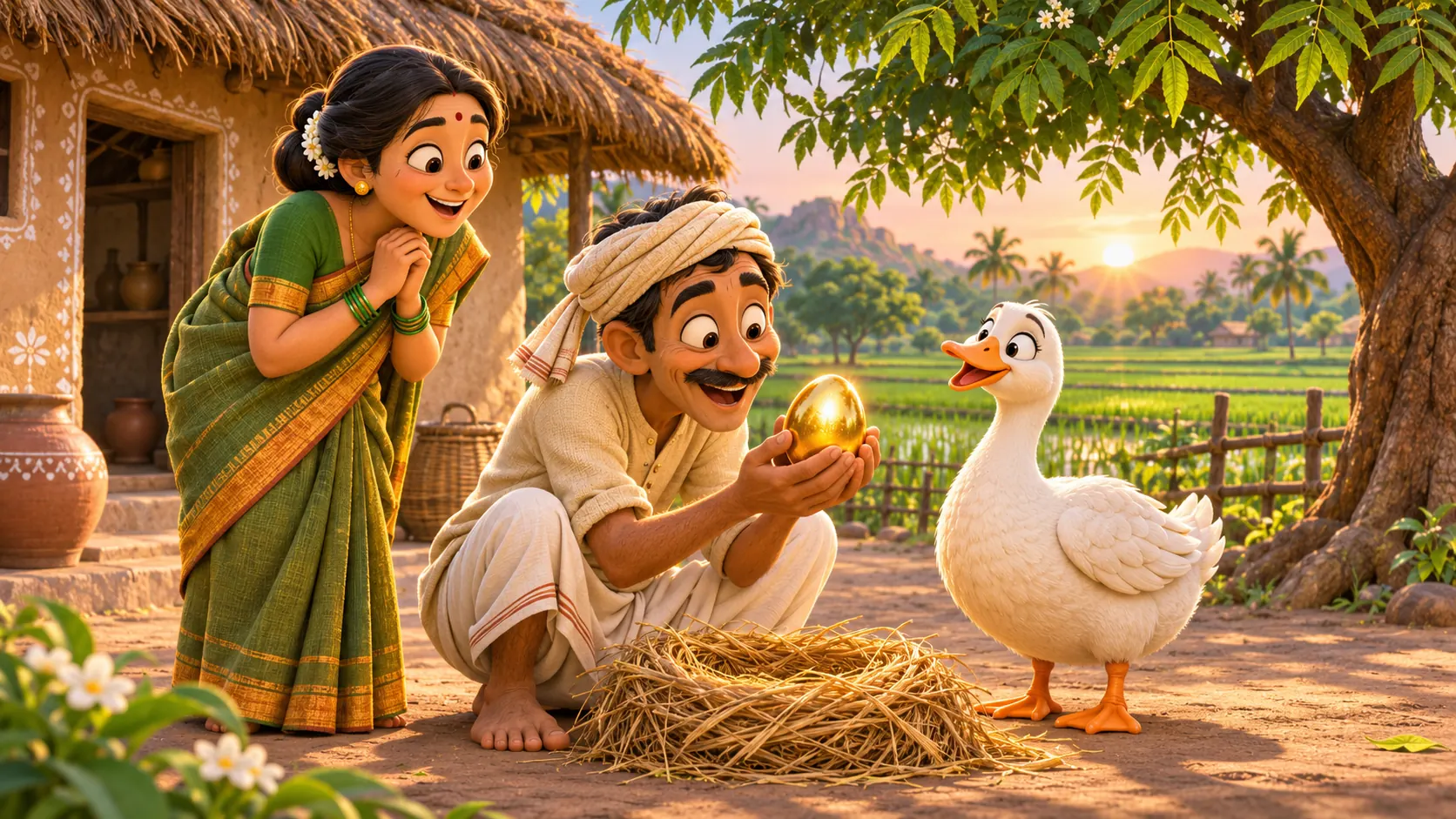
The next morning, Meg went out to feed Goldie and stopped still. In the straw lay an egg, but it was not white. It shone in the early sun like a little lamp. "Tom! Come quickly!" she called. Tom ran out, picked up the egg and nearly dropped it. It was heavy, cold and smooth. "Meg," he whispered, "I think this egg is made of gold."
Tom wrapped the egg in a cloth and walked all the way to the goldsmith in town. The goldsmith rubbed it, weighed it and raised his eyebrows. "This is pure gold," he said, and he paid Tom more money than he had ever held in his life. Tom hurried home, and that night he and Meg ate a full meal of rice, dal and sweet jalebis. Goldie sat in her nest and watched them with her calm black eyes.
The next morning there was another golden egg in the nest, and the morning after that, another. Every single day, Goldie laid just one golden egg. Tom sold them one by one. Soon the leaking hut became a strong brick house. Meg had new saris, Tom had new sandals and a fine turban, and their kitchen was always full. Meg put some of the money away in a tin box. "For a rainy day," she said.
But as the months went by, Tom began to change. He no longer smiled when he found the egg each morning. Instead he frowned and grumbled. "Only one egg a day," he muttered. "At this rate, how long will it take to become the richest man in the district?" He paced around the yard, staring at Goldie. "She lays gold every day," he said to himself. "She must be full of gold inside. Why should I wait?"
One evening Tom told Meg his plan. "If I open up the goose," he said, "I can take out all the gold at once. We will never have to wait again." Meg's face went pale. "Please don't!" she cried. "Goldie gives us a gift every morning. Be grateful for what we have." But Tom's mind was full of shining gold, and he would not listen to a word.
Early the next morning, before Meg woke, Tom crept out to the yard where Goldie sat on her straw nest. He did not let himself think. He took a knife, and in one terrible moment the goose was gone. Then he looked for the gold. But there was none. Inside, Goldie was just like any other goose. There was no treasure, no shining lump, not even a speck of gold.
Tom sank down on the ground beside the empty nest. There would be no egg that morning, or the next, or ever again. When Meg came out, she saw everything and began to cry. In time, they lived on the money from Meg's tin box, and slowly it grew smaller. Tom often sat by the empty nest in the evenings. "I had a gift every day," he would say softly, "and I threw it away because I could not wait."
Meet Tom, Meg and Goldie
Tom is a hardworking farmer who has been poor for a long time, and when good luck finally comes, he cannot stop wanting more. Meg, his wife, is cheerful and sensible; she is thankful for each golden egg and saves for the future. Goldie is a gentle white goose with orange feet and calm black eyes who lays one golden egg every morning. Together they show how gratitude keeps a gift safe, and how greed and impatience can lose it forever.
The moral
Greed can destroy the very thing that brings us good. Goldie gave Tom and Meg a golden egg every morning, enough to change their whole life. But Tom was not patient or grateful. He wanted everything at once, and in trying to grab it all, he lost the goose and every egg she would ever have laid. Be patient, be thankful for what you have, and look after the things that bring good into your life.
The story in 10 lines
Show the 10 linesHide the 10 lines
- Tom was a poor farmer who lived in a small village with his wife, Meg.
- One day Tom bought a white goose at the market, and Meg named her Goldie.
- The next morning, Meg found a shining egg of real gold in Goldie's nest.
- Every morning after that, Goldie laid one golden egg, and Tom sold it in town.
- Soon Tom and Meg had a big house, fine clothes and plenty of food.
- But Tom grew impatient and did not want to wait for one egg a day.
- He thought Goldie must be full of gold inside and decided to take it all at once.
- Meg begged him to stop, but Tom took a knife, and in one terrible moment the goose was gone.
- Inside, Goldie was just like any other goose, and there was no gold at all.
- With no more golden eggs, Tom and Meg had only what they had saved, and Tom deeply regretted his greed.
Questions to discuss
Talk about how Meg and Tom felt about the golden eggs at first, and how Tom's feelings changed over time. Ask what Tom could have done instead of hurting Goldie, and what good things in your own family are worth being patient and thankful for. You could also talk about the saying “Don't kill the goose that lays the golden eggs” and where you might use it.
Where did Tom get the goose Goldie?
He bought her from an old woman at the edge of the village market on a market day, using a few coins left over from selling his lentils.
How did Tom and Meg become rich?
Every morning Goldie laid one golden egg. Tom sold each egg to the goldsmith in town, and soon they had a brick house, new clothes and plenty of food.
Why did Tom decide to cut the goose open?
He grew impatient and greedy. He did not want to wait for one egg a day, and he thought Goldie must be full of gold inside, so he could take it all at once.
What happened after Tom killed the goose?
There was no gold inside; Goldie was just like any other goose. The golden eggs stopped forever, and Tom and Meg had to live on what Meg had saved.
Is The Goose that Laid the Golden Eggs an Aesop's fable?
Yes. It is a traditional fable attributed to Aesop, the storyteller of ancient Greece. It gave English the saying “to kill the goose that lays the golden eggs,” which means to destroy something valuable out of greed or impatience. It is retold here with an Indian village setting.